Comparing heat drying versus traditional air movers for faster basement recovery in Fairfield
Basement flooding in Fairfield demands fast action to prevent mold growth and structural damage. Heat drying and traditional air movers both remove moisture but through different mechanisms. Heat drying uses thermal energy to accelerate evaporation while air movers rely on airflow and dehumidification. Understanding these differences helps you choose the right method for your specific situation. What to Do When Your Indian Hill Basement Floods Unexpectedly.
Fairfield’s humid Ohio summers create unique challenges for water damage restoration. Traditional air movers often struggle when outside humidity exceeds 70%, making it difficult to achieve the low vapor pressure differentials needed for rapid drying. Heat drying bypasses this limitation by raising the temperature of materials directly, allowing faster moisture removal even in high-humidity conditions. Water Damage Restoration Blue Ash.
The decision between heat drying and air movers affects not just drying speed but also restoration costs, equipment requirements, and the likelihood of secondary damage like mold growth. Heat drying typically reduces drying times by 50-70% compared to traditional methods, but requires specialized equipment and higher energy consumption. Air movers remain the standard for many situations due to lower equipment costs and simpler setup procedures.
This comparison examines the science behind each method, cost considerations, and specific scenarios where one approach outperforms the other in Fairfield’s unique climate conditions.
How traditional air movers remove basement moisture
Traditional air movers work through the principle of enhanced evaporation. These high-velocity fans create constant airflow across wet surfaces, breaking the boundary layer of saturated air that naturally forms above damp materials. This process accelerates evaporation but depends heavily on maintaining low relative humidity in the surrounding air.
Air movers require companion dehumidifiers to remove the moisture they liberate from surfaces. Low Grain Refrigerant (LGR) dehumidifiers are most common in water damage restoration. They work by pulling in humid air, cooling it below the dew point to condense water vapor, then reheating and exhausting the dry air back into the space.
The effectiveness of air movers depends on psychrometric conditions. In Fairfield’s summer climate, outdoor relative humidity often exceeds 75%, forcing dehumidifiers to work harder and reducing overall drying efficiency. The system struggles to maintain the vapor pressure differentials needed for rapid moisture removal from dense materials like concrete and hardwood. Restoring Your Hardwood Floors After Water Damage in Madeira.
Air movers excel at drying carpet padding, drywall, and other porous materials. They require strategic placement in corners, under cabinets, and behind baseboards to ensure complete coverage. Technicians typically use multiple units to create airflow patterns that reach all affected areas.
The process demands continuous monitoring of temperature, humidity, and moisture content readings. Technicians adjust equipment placement and settings throughout the drying process to optimize performance. This method works well for Category 1 water losses but becomes less efficient for Category 2 or 3 contamination scenarios.

Image shows a technician setting up air movers and dehumidifiers in a flooded basement. Equipment placement demonstrates proper airflow patterns across wet surfaces with dehumidifiers positioned to capture moisture-laden air.
Heat drying technology and its advantages
Heat drying uses thermal energy to accelerate the molecular movement of water within materials. By raising material temperatures to 100-120°F, heat drying increases the vapor pressure of water inside the material, forcing moisture to migrate toward the surface where it can evaporate regardless of ambient humidity levels.
This method employs specialized equipment like the TES (Thermal Energy System) or E-TES (Electric Thermal Energy System). These units generate controlled heat and direct it through flexible ducting to target specific areas. The heat penetrates materials deeply, addressing moisture trapped in subfloors, wall cavities, and concrete slabs.
Heat drying eliminates the humidity dependency that limits air movers. Even when outdoor humidity exceeds 80%, heated materials continue releasing moisture at accelerated rates. This makes heat drying particularly effective for Fairfield’s summer conditions when traditional methods struggle to maintain low vapor pressure differentials.
The technology works through convection and conduction. Heated air rises naturally, creating circulation patterns that distribute warmth throughout the affected area. Direct contact with heated surfaces transfers thermal energy into materials, raising their internal temperature and vapor pressure.
Heat drying requires careful temperature monitoring to prevent damage to sensitive materials. Technicians use infrared thermometers and moisture meters to track surface temperatures and moisture content. The process typically maintains temperatures below 120°F to protect wood flooring, cabinetry, and other heat-sensitive materials.
Equipment includes not just heat generators but also air scrubbers to manage airborne particulates and moisture sensors to track progress. The setup is more complex than air movers but achieves results in significantly less time for many material types.
Side-by-side comparison of drying performance
| Factor | Heat Drying | Air Movers |
|---|---|---|
| Average drying time | 24-48 hours | 72-120 hours |
| Energy consumption | High (electric or propane) | Moderate (multiple fans) |
| Humidity dependency | Low | High |
| Equipment cost | $2,000-5,000 per unit | $200-500 per unit |
| Setup complexity | High | Low |
| Best for materials | Concrete, hardwood, tile | Carpet, drywall, insulation |
| Mold prevention window | 48-72 hours | 24-48 hours |
Heat drying demonstrates clear advantages for Fairfield’s climate conditions. The method’s independence from ambient humidity proves crucial during Ohio’s muggy summers when traditional drying methods lose efficiency. Concrete basement floors and hardwood surfaces respond particularly well to heat application.
Air movers maintain advantages for certain applications. Their lower equipment costs make them economical for small jobs or when drying time is less critical. They excel at drying carpet and padding, which respond well to enhanced airflow without requiring high temperatures.
The choice often depends on material composition and contamination level. Heat drying handles Category 2 and 3 water losses more effectively by accelerating the removal of contaminated moisture from materials. Air movers work best for clean water losses where time constraints are less severe.
When heat drying proves essential
Heat drying becomes necessary when time constraints demand rapid restoration. Insurance companies often prefer heat drying for commercial properties where business interruption costs exceed equipment rental fees. The 50-70% reduction in drying time translates directly to faster reoccupancy and reduced liability exposure.
Hardwood flooring represents a critical application for heat drying. Traditional air movers often fail to extract moisture from wood’s cellular structure before warping and cupping occur. Heat penetrates the wood, raising internal vapor pressure and allowing moisture to escape before permanent damage sets in.
Concrete slab foundations benefit significantly from heat drying. Concrete’s low permeability makes moisture removal extremely slow with air movers alone. Heat accelerates moisture migration from deep within the slab to the surface where dehumidifiers can capture it. This proves essential for basement floors in Fairfield’s older homes.
Specialty materials like plaster, stone, and brick masonry respond better to heat drying than air movement. These dense materials trap moisture in their pores and capillaries, requiring elevated temperatures to increase vapor pressure enough for effective moisture migration.
Category 3 water losses from sewage or flooding demand heat drying’s superior contamination removal capabilities. The elevated temperatures help break down organic compounds while accelerating moisture removal from contaminated materials. This reduces the window for bacterial growth and secondary contamination. Fast Sewage Backup Cleanup Services for Over-the-Rhine Businesses.
Large commercial spaces with high ceilings benefit from heat drying’s natural convection patterns. The rising warm air creates circulation that reaches areas difficult to access with floor-mounted air movers. This proves valuable in warehouses, retail stores, and office buildings. Retail Store Water Cleanup.
Cincinnati humidity challenges for traditional drying
Fairfield sits within Cincinnati’s humid continental climate zone, where summer relative humidity regularly exceeds 70%. This creates fundamental challenges for traditional air mover systems that depend on maintaining low vapor pressure differentials for effective drying.
When outdoor humidity exceeds 60%, dehumidifiers must work continuously to maintain the moisture gradient needed for rapid evaporation. This increases energy consumption and extends drying times. During Cincinnati’s July and August peak humidity months, traditional drying can take 200-300% longer than during drier seasons.
The Ohio River valley geography amplifies humidity effects. Fairfield’s proximity to the Great Miami River and local tributaries creates microclimates with higher moisture content than surrounding areas. Morning fog and evening condensation are common, indicating the high moisture load these systems must overcome.
Soil composition affects basement moisture challenges. Fairfield’s clay-heavy soils retain water and release it slowly through foundation walls. This creates continuous moisture sources that traditional drying must combat while trying to remove flood water from interior spaces.
Building construction methods common in Fairfield exacerbate humidity challenges. Many homes built before 2000 lack proper vapor barriers and use construction techniques that allow moisture migration through walls and floors. Traditional drying must overcome both the initial water intrusion and ongoing moisture migration from surrounding materials.
Heat drying circumvents these humidity limitations by directly heating materials rather than depending on ambient conditions. This makes it particularly valuable for Fairfield’s climate, where traditional methods may require 5-7 days to achieve results that heat drying accomplishes in 1-2 days.
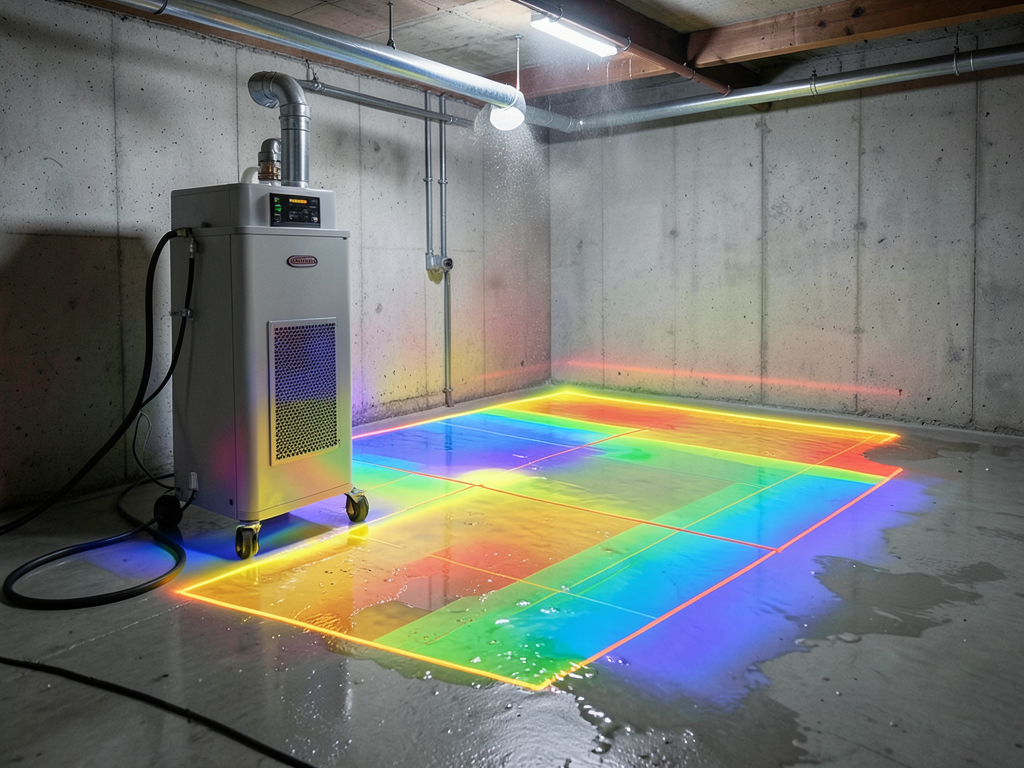
Image shows heat drying equipment setup with thermal imaging overlay demonstrating temperature distribution across a flooded basement floor. The thermal patterns show how heat penetrates concrete and reaches trapped moisture pockets.
Cost analysis and return on investment
Heat drying equipment rental costs range from $500-1,500 per day depending on the system size and power source. A typical residential job requires 2-3 days of operation, resulting in equipment costs of $1,500-4,500. Air movers cost $50-100 per unit per day, with a typical job using 8-12 units over 3-5 days.
Energy consumption creates the largest cost differential. Heat drying systems draw 15-30 amps at 240 volts, consuming 3,600-7,200 watts continuously. Over a 48-hour period, this equals 172-345 kilowatt-hours. At current Ohio electricity rates of $0.13 per kWh, energy costs range from $22-45.
Air movers consume less power individually but require more units. Twelve air movers at 2 amps each draw 24 amps total. Over 120 hours, they consume approximately 288 kilowatt-hours, costing $37-45 in electricity. The energy cost difference is minimal, but heat drying achieves results in one-third the time.
Labor costs favor heat drying despite higher equipment complexity. Heat drying technicians complete setup in 2-3 hours versus 4-6 hours for air mover systems. The reduced monitoring requirements and faster completion times offset higher per-hour rates for heat drying specialists.
Secondary damage prevention represents the largest potential cost savings. Heat drying’s faster moisture removal reduces mold growth risk, preventing $2,000-10,000 in remediation costs. It also minimizes swelling and warping of wood materials, saving thousands in floor and cabinet repairs. EPA Mold Guidelines.
Insurance considerations affect cost analysis. Many policies cover water damage restoration but exclude mold damage occurring after the initial loss. Heat drying’s mold prevention benefits can mean the difference between a covered claim and denied secondary damage.
Business interruption costs favor heat drying for commercial properties. A retail store closed for 5 days loses significantly more revenue than one closed for 2 days. The higher restoration cost often proves economical compared to lost sales and customer goodwill.
Real-world success in a Cincinnati property
A Fairfield homeowner returned from vacation to find their finished basement flooded from a failed sump pump during a July thunderstorm. The basement contained 1,500 square feet of finished space with carpet, drywall, and hardwood flooring in the entertainment area.
Initial moisture readings showed standing water at 1/2 inch depth with carpet and padding fully saturated. The concrete slab registered 18% moisture content, while hardwood flooring measured 15% (normal is 6-8%). Outside humidity measured 78% with thunderstorms predicted for the next 48 hours.
The restoration team deployed heat drying equipment, positioning thermal units to direct heat under the hardwood flooring through existing vents. Air scrubbers maintained air quality while moisture sensors tracked progress in wall cavities and subfloor spaces. The system maintained 110°F temperatures at floor level while keeping ambient air comfortable.
Within 24 hours, hardwood moisture content dropped to 9%, concrete slab measured 12%, and carpet padding showed no detectable moisture. The entire basement dried in 36 hours total, well before the approaching storms arrived. Traditional air mover setup would have required 5-6 days under the same conditions.
The homeowner avoided $8,000 in hardwood floor replacement costs and prevented mold growth that would have required $5,000-12,000 in remediation. The total restoration cost was $3,200, compared to an estimated $6,500 for traditional drying plus secondary damage repairs.
This case demonstrates heat drying’s value in Fairfield’s humid climate. The method’s ability to work independently of ambient conditions proved crucial during a weather pattern that would have severely hampered traditional drying methods.
Image shows before and after moisture meter readings from a successful heat drying job. The display shows initial high moisture readings transitioning to normal levels, with thermal imaging demonstrating heat penetration into flooring materials.
Making the right choice for your situation
Heat drying proves optimal when time is critical, materials are expensive, or contamination levels are high. Fairfield homeowners with hardwood floors, finished basements, or valuable contents should consider heat drying when flooding occurs. The method’s superior performance with concrete and specialty materials makes it ideal for basement environments.
Traditional air movers remain appropriate for clean water losses in unfinished spaces, when budget constraints dominate, or when the property will be unoccupied during the extended drying period. They work well for carpet and drywall when humidity levels are moderate and time allows for slower drying.
Professional assessment determines the optimal approach. Certified technicians evaluate water category, material types, contamination levels, and local weather conditions before recommending a drying strategy. This assessment should occur within hours of water discovery to maximize restoration options.
Consider your specific circumstances. Do you have irreplaceable hardwood floors? Is your basement fully finished with expensive materials? Are storms approaching that will raise outdoor humidity? These factors influence whether heat drying’s premium cost provides worthwhile value.
Insurance coverage affects your decision. Some policies prefer traditional methods due to lower upfront costs, while others support heat drying when it prevents more expensive secondary damage. Your restoration company should work directly with insurance adjusters to determine covered options.
Don’t wait until water damage occurs to make this decision. Understanding your options before an emergency helps you respond quickly when time matters most. Keep contact information for restoration companies that offer both methods, allowing flexibility when disaster strikes.
Frequently Asked Questions
Is heat drying safe for my home and belongings?
Yes, when properly managed by certified technicians. Heat drying maintains temperatures below 120°F, which is safe for most building materials. Technicians monitor temperatures continuously and adjust settings to protect heat-sensitive items. The process includes air filtration to manage airborne particles and maintain indoor air quality.
How much faster is heat drying than traditional methods?
Heat drying typically reduces drying time by 50-70%. A job requiring 5-7 days with air movers often completes in 24-48 hours with heat drying. This time savings proves most dramatic in Fairfield’s humid summer conditions when traditional methods lose efficiency due to high outdoor humidity levels.
Will my insurance cover heat drying?
Most homeowner insurance policies cover water damage restoration, including heat drying, when it’s the appropriate method for the loss. Some policies require pre-authorization or have specific provisions for drying methods. Your restoration company should work directly with your insurance adjuster to determine coverage and obtain necessary approvals.
Can I use heat drying for small water spills?
Heat drying is most cost-effective for significant water losses affecting multiple rooms or specialty materials. For small spills under 100 square feet, traditional air movers often provide adequate drying at lower cost. The break-even point depends on material types and time sensitivity of the situation.
What happens if I choose the wrong method?
Choosing air movers for a situation better suited to heat drying extends drying time and increases mold risk. Choosing heat drying for a simple carpet spill wastes money without providing benefits. Professional assessment prevents these mistakes by matching the drying method to your specific water damage scenario.
Take action before secondary damage begins
Water damage in Fairfield basements demands immediate professional attention. Every hour of delay increases restoration costs and mold risk, particularly during Ohio’s humid summer months. Heat drying and traditional air movers both offer effective solutions, but the right choice depends on your specific situation.
Don’t gamble with your home’s structural integrity or your family’s health. Professional water damage restoration requires specialized equipment, proper training, and rapid response capabilities. The decision between heat drying and air movers should be made by certified technicians who can assess your unique circumstances.
Pick up the phone and call (513) 717-2522 today to schedule your inspection. Our certified technicians arrive within 60 minutes, assess your situation, and recommend the optimal drying strategy. We work directly with your insurance company and guarantee our restoration work. Don’t let water damage escalate into a more expensive problem.
Call (513) 717-2522 now. Every minute counts when water threatens your Fairfield home.
Act fast. Call (513) 717-2522 before the next storm hits and your basement floods again. For more information, visit IICRC S500 Standard.
{
“@context”: “https://schema.org”,
“@type”: “BlogPosting”,
“headline”: “Comparing heat drying versus traditional air movers for faster basement recovery in Fairfield”,
“description”: “Discover which water damage drying method works faster in Fairfield basements. Compare heat drying vs air movers for speed, cost, and effectiveness in Cincinnati’s humid climate.”,
“wordCount”: 2817,
“datePublished”: “2026-05-14T10:00:00.000Z”,
“dateModified”: “2026-05-14T10:00:00.000Z”,
“inLanguage”: “en-US”,
“mainEntityOfPage”: {
“@type”: “WebPage”,
“@id”: “https://acewaterdamagerestorationcincinnati.com”
},
“publisher”: {
“@type”: “LocalBusiness”,
“name”: “Ace Water Damage Restoration Cincinnati”,
“url”: “https://acewaterdamagerestorationcincinnati.com”
},
“author”: {
“@type”: “Organization”,
“name”: “Ace Water Damage Restoration Cincinnati”,
“url”: “https://acewaterdamagerestorationcincinnati.com”
},
“image”: {
“@type”: “ImageObject”,
“url”: “https://acewaterdamagerestorationcincinnati.com/wp-content/uploads/2026/03/comparing-heat-drying-versus-traditional-air-mover-1.png”
}
}
{
“@context”: “https://schema.org”,
“@type”: “LocalBusiness”,
“name”: “Ace Water Damage Restoration Cincinnati”,
“url”: “https://acewaterdamagerestorationcincinnati.com”,
“address”: {
“@type”: “PostalAddress”,
“addressLocality”: “Cincinnati”
},
“areaServed”: {
“@type”: “City”,
“name”: “Cincinnati”
}
}
{
“@context”: “https://schema.org”,
“@type”: “FAQPage”,
“mainEntity”: [
{
“@type”: “Question”,
“name”: “Is heat drying safe for my home and belongings?”,
“acceptedAnswer”: {
“@type”: “Answer”,
“text”: “Yes, when properly managed by certified technicians. Heat drying maintains temperatures below 120°F, which is safe for most building materials. Technicians monitor temperatures continuously and adjust settings to protect heat-sensitive items. The process includes air filtration to manage airborne particles and maintain indoor air quality.”
}
},
{
“@type”: “Question”,
“name”: “How much faster is heat drying than traditional methods?”,
“acceptedAnswer”: {
“@type”: “Answer”,
“text”: “Heat drying typically reduces drying time by 50-70%. A job requiring 5-7 days with air movers often completes in 24-48 hours with heat drying. This time savings proves most dramatic in Fairfield’s humid summer conditions when traditional methods lose efficiency due to high outdoor humidity levels.”
}
},
{
“@type”: “Question”,
“name”: “Will my insurance cover heat drying?”,
“acceptedAnswer”: {
“@type”: “Answer”,
“text”: “Most homeowner insurance policies cover water damage restoration, including heat drying, when it’s the appropriate method for the loss. Some policies require pre-authorization or have specific provisions for drying methods. Your restoration company should work directly with your insurance adjuster to determine coverage and obtain necessary approvals.”
}
},
{
“@type”: “Question”,
“name”: “Can I use heat drying for small water spills?”,
“acceptedAnswer”: {
“@type”: “Answer”,
“text”: “Heat drying is most cost-effective for significant water losses affecting multiple rooms or specialty materials. For small spills under 100 square feet, traditional air movers often provide adequate drying at lower cost. The break-even point depends on material types and time sensitivity of the situation.”
}
},
{
“@type”: “Question”,
“name”: “What happens if I choose the wrong method?”,
“acceptedAnswer”: {
“@type”: “Answer”,
“text”: “Choosing air movers for a situation better suited to heat drying extends drying time and increases mold risk. Choosing heat drying for a simple carpet spill wastes money without providing benefits. Professional assessment prevents these mistakes by matching the drying method to your specific water damage scenario.”
}
}
]
}
{
“@context”: “https://schema.org”,
“@type”: “BreadcrumbList”,
“itemListElement”: [
{
“@type”: “ListItem”,
“position”: 1,
“name”: “Home”,
“item”: “https://acewaterdamagerestorationcincinnati.com”
},
{
“@type”: “ListItem”,
“position”: 2,
“name”: “Blog”,
“item”: “https://acewaterdamagerestorationcincinnati.com/blog”
},
{
“@type”: “ListItem”,
“position”: 3,
“name”: “Comparing heat drying versus traditional air movers for faster basement recovery in Fairfield”
}
]
}
{
“@context”: “https://schema.org”,
“@type”: “Service”,
“serviceType”: “Water Damage Restoration”,
“provider”: {
“@type”: “LocalBusiness”,
“name”: “Ace Water Damage Restoration Cincinnati”,
“url”: “https://acewaterdamagerestorationcincinnati.com”
},
“areaServed”: {
“@type”: “City”,
“name”: “Cincinnati”
},
“description”: “Discover which water damage drying method works faster in Fairfield basements. Compare heat drying vs air movers for speed, cost, and effectiveness in Cincinnati’s humid climate.”
}